Handstand Practice: From Curiosity to a Way of Life | Fyra Yoga
Genevieve shares how handstand practice taught her patience, strength, body awareness, and trust while opening the door to a global community.


It all started one Saturday at noon, in a Power Flow class at Moksha Montréal. Yes, before Fyra, before Modo, there was Moksha.
At that point, I had been practicing Bikram yoga religiously for more than a year. I thought I had a pretty good understanding of the physical side of yoga. After all, I knew my 26 postures, I was getting stronger, and I was constantly trying to go a little deeper. Sometimes, admittedly, I was pushing past what my body was actually asking for. But that’s a story for another day.
After experimenting with a few Moksha classes and getting a taste of Moksha Flow, I finally decided I was ready for Power Flow. I had no idea what I was walking into.
Everyone seemed to know everyone. People greeted the staff like old friends. They walked into the studio and headed straight for their usual spot, with the confidence of people who apparently had assigned seats. Then, after class, conversations continued in the changing room as though everyone had simply met up for their weekly brunch.
I was slightly intimidated by this very established little ecosystem. So I did what any socially confident person would do: I found a corner and disappeared.
And then I saw it. Bodies moving together in perfect rhythm. The energy of the room. The speed, strength and control. People moving in and out of shapes that seemed to completely disregard the laws of gravity. I was hooked.
That class would eventually have a huge influence on my future as a yoga teacher. But more importantly, it planted a little idea in my head. I wanted to practice handstands.
.jpg)
The Day Everything Changed
Learning to handstand as an adult is not exactly a straight line. There is a lot of falling. A lot of frustration. A lot of questioning your life choices. And, especially in the beginning, a very strong temptation to quit.
Because nothing really works. You kick up and immediately come back down. You kick harder and fly right over. You try to be more controlled and suddenly you don't have enough momentum. So you try again. And again. And again.
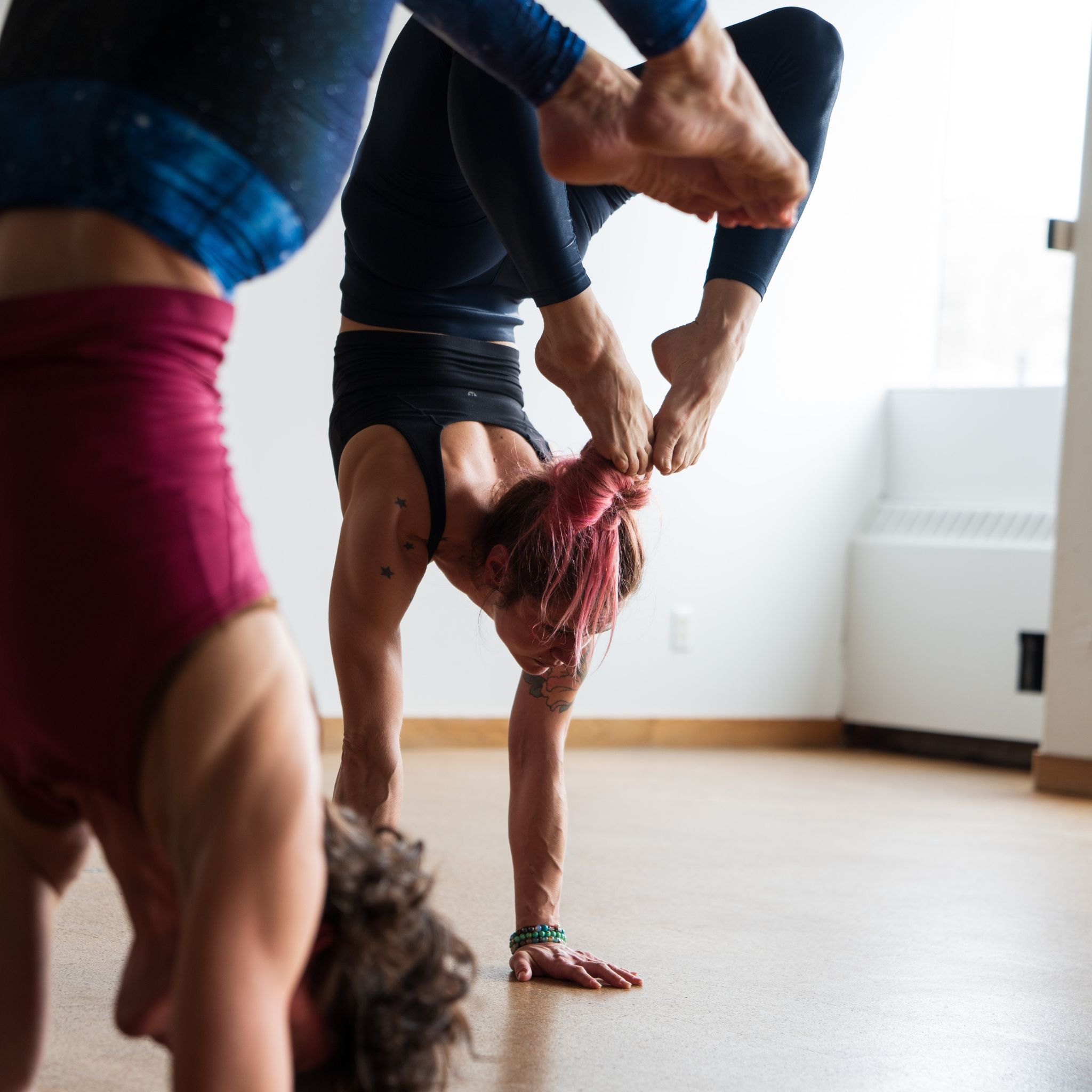
Until one day, something clicks. It might only last a few seconds, but suddenly everything feels different. Your body finds the line. Your hands feel grounded. Your legs float overhead. And you’re there. For a few beautiful seconds, the world goes quiet.
What started as a curiosity became an obsession. And eventually, much more than that. It became a way of life.
Falling in Love With the Process
Getting into hand balancing means getting to know a completely different version of yourself. One that needs patience. One that needs discipline, persistence, and just enough stubbornness to keep showing up when absolutely nothing seems to be working.
Because the effortless handstands you see online, or in a studio, are rarely effortless.
Behind those few seconds of seemingly perfect balance are hundreds of hours of practice. Alone. With friends. With coaches. Falling. Trying again. Falling some more. The handstand looks simple. It isn't.
Strength is only part of the equation. You also need mobility, coordination, body awareness, precision, balance, and an almost ridiculous amount of patience.
Eventually, you realize that the only way forward is to fall in love with the process itself. And that's not always easy. Progress is anything but linear.
One day, everything works. You feel like you've finally cracked the code. You find your balance again and again and start thinking, Okay. I've got this.
Then you wake up the next day and apparently you've forgotten how your own body works. Your legs won't come up. Your balance is nowhere to be found. Nothing feels familiar. You start wondering if yesterday even happened.
This is where you learn not to get too attached to the good days. In the beginning, progress can be incredibly inconsistent. You might hold for three seconds, then two. Five seconds on Tuesday, one second on Wednesday.
Sometimes, handstand practice feels like starting from scratch every time. But you're not. Your body is learning. It's building new connections. It's getting stronger, more coordinated, more aware. The progress is happening, even when you can't see it. And every little breakthrough matters.

Balance Is Only the Beginning
Eventually, if you keep showing up, those few seconds start to become more reliable. And that's when things get dangerous. Because once you can hold a straight handstand, you naturally start wondering: What else can I do?
Suddenly, you want to play with your legs. Try different shapes. Explore dynamic balance. Work on press handstands. Figure out how to enter and exit with control.
And eventually, you look up at the next mountain. The one-arm handstand. And, just like that, you're a beginner again.
You have to learn how to fail at something new. You have to be comfortable not knowing. You have to fall, adjust, and start over.
Which might be one of the biggest lessons hand training has taught me: There is no real finish line. There is always another skill. Another variation. Another way to explore movement.
More Than Just a Handstand
As frustrating as the journey can be, hand balancing has become one of the most rewarding and transformative experiences of my life.
It has pushed me far beyond what I thought I was capable of. It has taught me discipline I didn't know I had. But most unexpectedly, it gave me a community.
I've met some truly incredible people through handstands. People who are just as passionate, curious, stubborn, and slightly obsessed with movement as I am. I've traveled around the world to learn from incredible hand balancers.
I've met people who have become close friends. I've found myself surrounded by a community of people who understand why you might willingly spend an hour trying to hold a handstand for three seconds... and leave the studio ridiculously happy.
From the outside, hand balancing can look like a very solitary pursuit. In reality, it opens the door to an entire world of friendships, travel, shared struggles, inside jokes, and very specific conversations about things like finger pressure and shoulder elevation.
It's a weird little world. An intense world. Sometimes a slightly obsessive world. But it's also one of the most welcoming communities I've ever stumbled into. And perhaps that's what surprised me most.
I thought I was learning to balance on my hands. Instead, I found a community. A discipline. A completely new relationship with my body and what it can do.
Somewhere between the falls, the breakthroughs, and the hundreds of attempts, I found a different way of moving through the world.
Of course, you don't have to take it that far. A handstand can simply be a fun party trick you pull out at dinner and immediately regret when everyone starts asking you to do it again.
But consider yourself warned. Proceed at your own risk. Highly addictive.
Explore our Handstand and Handstand Conditioning classes in Montreal, and check the schedule to join Genevieve on the mat.
Explore Other Articles